The Let There Be Night team created an original planetarium program that addresses outdoor lighting issues. We also bundled related content from other providers onto a Let There Be Night DVD with permission of the original copyright holders. Each segment is a different chapter on the DVD, allowing multiple users to interweave the selected chapters that are most suitable for their facility and audience with their live presentations. The 2-DVD set can be purchased for the cost of duplication and shipping through the Great Lakes Planetarium Association at the GLPA Online Store.
 Let There Be Night Planetarium Program
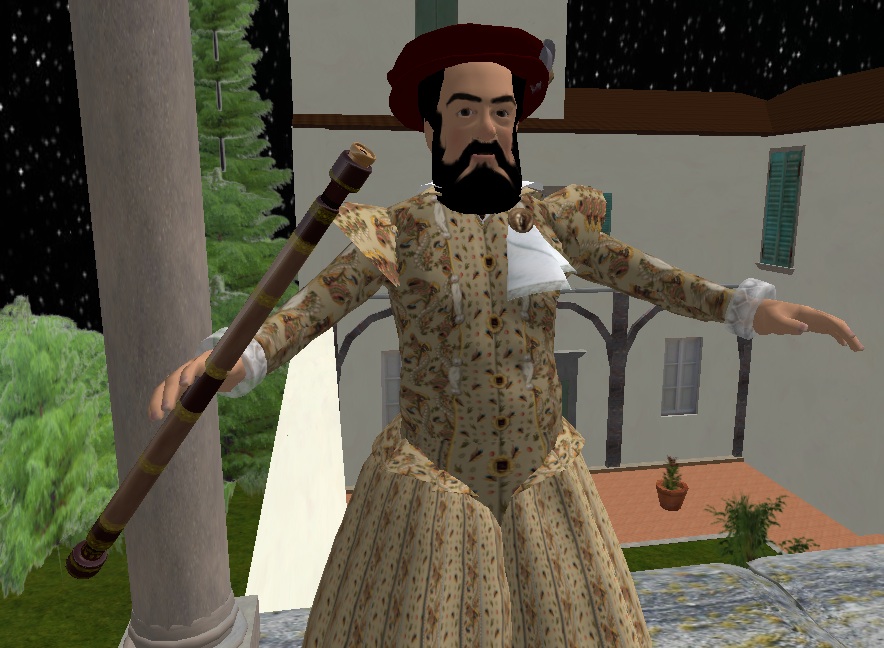
The planetarium program features original narrated video that can be shown in a planetarium or be used as a stand-alone video. The intention is for small and portable planetariums to take advantage of their interactive capability by weaving portions from the DVD with in-dome activities, such as the Maglite® demo. The main characters are two avatars, Galileo and a visitor from the future. The scenes are animation taken from a Second Life virtual world, noted below, which appears on the Astronomy 2009 Island. Ten selectable chapters include:
- IYA2009 opening trailer
- Galileo and his major discoveries;
- Introduction to outdoor lighting issues;
- What is at risk and solutions
- Quantifying light pollution;
- The future of telescopes and the night sky.
Galileo avatar: "Gosh, dim it all!"
 Let There Be Night DVD for Multiple Users
Because the Let There Be Night DVD can hold more data than just the planetarium program, we will add new or existing dark sky resources that other parties have generously contributed with permission to duplicate. A partial list of the DVD contents includes:
- Let There Be Night original planetarium program, which can be a stand-alone video as well;
- Saving the Night, written and narrated by David Levy, and re-distributed courtesy of the Southeastern Planetarium Association;
- There Once Was a Sky Full of Stars, written by Bob Crelin and illustrated by Amie Ziner; includes complete narrated video as well as individual components;
- “Ant Dances for Light”, a Pacific Northwest Nations story told by Dovie Thomason (Kiowa Apache/Lakota). The Day and Night audio recording, excerpted from the Lunar and Planetary Institute’s SkyTellers series, is used with permission of LPI, Thomason, and Lynn Moroney;
- Stars Above, Earth Below, a video capturing the magnificence of the night from Tyler Nordgren's tour of US National Parks; images and narration courtesy of Nordgren;
- Dark Matters, an introduction (~15 minutes) to outdoor lighting issues; video written by John McMahon and produced by Danl DuRall;
- Perpetual Twilight, a PowerPoint presentation for dark sky advocacy; courtesy of the Illinois Coalition for Responsible Outdoor Lighting;
- Stellarium planetarium script on magnitudes and the respective diminishing starfields, courtesy of Karrie Berglund;
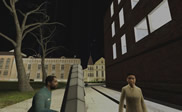 DarkSkies, an animated video segment conveying the impact of light pollution on sidewalk astronomy (right); courtesy of Tim Brothers (astrobrothers at gmail.com);
- Globe at Night teacher and family activity packets, and resources from the National Optical Astronomy Observatory.
- GEMS Observing the Jupiter System activity that simulates the positions of Jupiter's moons as observed by Galileo; courtesy of Alan Gould and Regents of UC.
- Using a Sky Quality Meter, a student video about using an SQM for Globe at Night; courtesy of Patrick Eme.
- In This Light song; performed by John Kaufmann and Dan Dennis; courtesy of Starball.
- Shoulders of Giants song; courtesy of ©Johannes Kepler Project. Words and Music by Padi Boyd. Performed by The Chromatics.
- Lucifer's Bait song; courtesy of Bandazian.
The Let There Be Night team is posting program notes, images, activities, and other supporting material online at this website.
SkyTellers: "The stories were not meant to explain these mysteries; rather, they were told to help people pay attention to our world." -Lynn Moroney
Sample Program
The Let There Be Night DVD contents are diverse so that multiple users can tailor it to their needs. Libraries, youth groups, city councils, astronomy clubs, classroom teachers, and planetarians can all find material that serves their respective audiences. Below is a sample outline of a program that could be presented in a portable planetarium:
- Open to a darkening sky with pre-recorded “Ant Dances for Light”, a Pacific Northwest Nations story told by Dovie Thomason (Kiowa Apache/Lakota).
- Introduce the need for light in modern society, yet allow participants to discover side effects of technology. Conduct in-dome demonstrations, using unshielded mini-flashlights in “candle mode” to guide participants to identify three aspects of light pollution (glare, light trespass, and sky glow) and to discover benefits of fully shielded lights.
- Present in-dome There Once Was a Sky Full of Stars, written by Bob Crelin and illustrated by Amie Ziner.
- Conduct a live, traditional presentation of constellations and celestial highlights at that time using the planetarium’s starfield.
- Introduce notion of magnitudes.
- Segue to the constellation Orion and present a live primer on how students and visitors contribute their observations of Orion to Globe at Night.
Spreading the Word: The 2-DVD set can be purchased for the cost of duplication and shipping through the Great Lakes Planetarium Association at the GLPA Online Store.
After the Visit
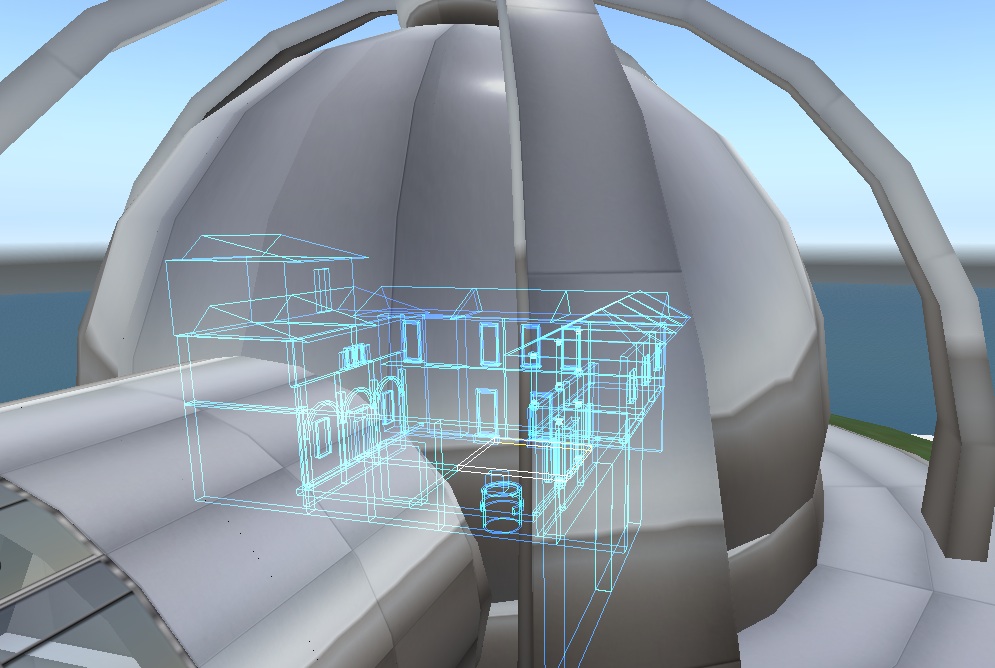 Let There Be Night offers a post-visit experience for older teens and adults in the virtual world of Second Life, where avatars can interact with nightscapes within a Holodeck-like structure. In one selectable envirionment, you can immerse yourself in an urban street scene with various types of outdoor lighting. By adjusting the lighting fixtures, the visitors can see the outcome of their actions on the nightscape, for better or for worse. In another scene, you can visit the courtyard of Galileo's villa in Arcetri, where he lived his later years under house arrest.
 As of December 2008, the interactive structure resides on CoLab Island at http://slurl.com/secondlife/NASA%20CoLab/151/98/702; however, it will move to Astronomy 2009 Island during the International Year of Astronomy. Designed by Itazura Radio of the Primagination Factory, the building contains the domed hologrid and a Great Hall, where other IYA2009 displays will be featured.
Virtual Scenarios: In the virtual world of Second Life, visitors can experience the trade-offs of outdoor lighting and propose solutions for lessening the impact of the technology on society.
We encourge groups large and small to follow up their visits with a meaningful activity that addresses outdoor lighting. One school district in northern Indiana is coordinating a significant observing campaign. All students in grades 3-8 will experience grade-appropriate excerpts from the program during their regular planetarium visit and conduct the subsequent star counting experiment. The project staff has met with the school principals to coordinate implementation of Let There Be Night and has visited each of the 14 schools twice to present to the teachers the roles of students and teachers alike. The two-disc DVD set and the Teachers web page give further details and guidance.
All 6,000+ students in grades 3-8 will observe Orion during a two-week span March 14-28,2009, that coincides with the international Globe at Night (GaN) program. The number of stars they see and count suggests the level of light pollution at the respective sites. They will match their observations of Orion with limiting magnitude star charts posted online at GaN and contained in the Let There Be Night DVD.
Concurrently, select teams of students from each of 14 schools within the district will quantify sky glow with hand-held Sky Quality Meters (SQMs). Each night, cloudy or clear, they will record the sky glow near school grounds and post the SQM values the next day in school. In class, teachers will guide students to share their observations and analyze the data. After reviewing and discussing the district-wide results, they will create a model from LEGO® blocks that shows how much of the night sky has been lost and present their findings to the School Board of Education.
Recommended Reading: Sky Lore from Planet Earth: stories from around the world...Orion. Author/illustrator/planetarian Dayle Brown shares the lore of Orion from multiple cultures in both hemispheres.
Other Planetarium Programs for IYA2009
 Let There Be Night will celebrate the International Year of Astronomy by embracing the US theme "Dark Skies are a Universal Resource." However, it is not the only planetarium feature in the pipeline. The team who is producing the 400 Years of the Telecope documentary will also partner with the planetarium community to create a companion program Two Small Pieces of Glass.